Patient lift systems help caregivers health professionals, caregivers and patients to safely and comfortably transfer and lift their patients. The systems are ideal for patients who have limited mobility. This includes elderly or those with disabilities, as well as patients recovering after injuries or surgeries.
In the market there are numerous types of lifts, like overhead Hoyer lifts as well as mechanical lift transfers and mobility lifts. In this post, we’ll examine each of these systems in depth and discuss the advantages of each.
Mechanical lift transfer
A mechanical lift transfer system is a patient lift that makes use of an electrical or hydraulic mechanism for lifting and moving patients. It consists of a lifting unit, a sling, and a base with wheels. The lift unit is attached to the sling that wraps around the user and then lifts them up from a sitting or lying position.
Mechanical lift transfers are an efficient solution for safe patient transfers in that it decreases the risk of injuries to both the patient and the caregiver. It also eases the physical strain on the caregiver’s body since the lift unit performs the majority of the heavy lifting. Mechanical lift transfers are also simple to maneuver within small space. This is why they are a great choice for home-based care.
Overhead hoyer lift
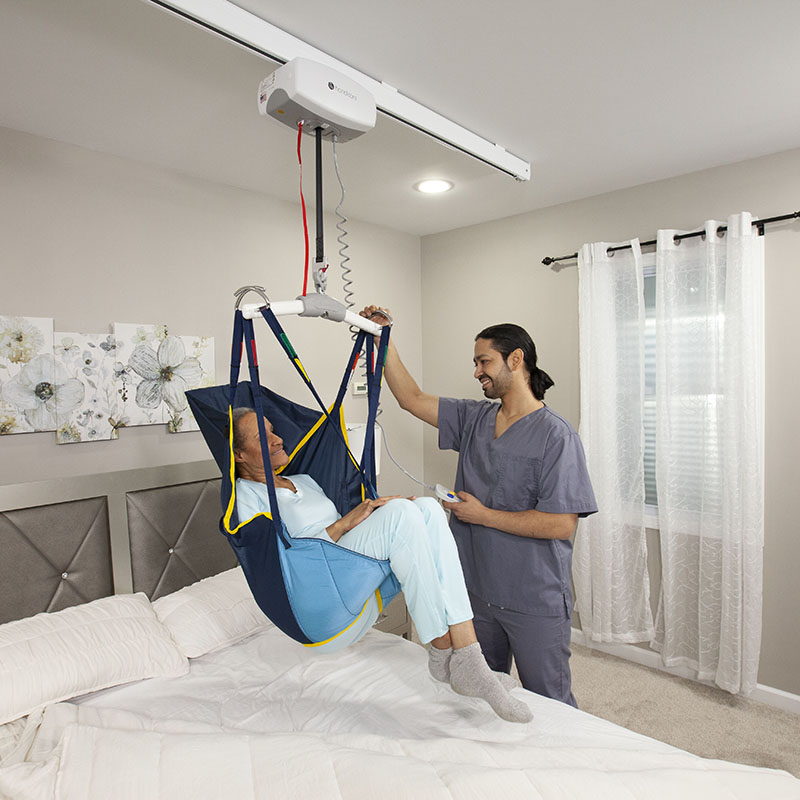
The overhead Hoyer Lift is a mechanical lift system that makes use of an overhead track to facilitate transfer of patients. It is made up of a track which is mounted on the ceiling and the lift unit attached to it. A sling wraps around the patient.
The overhead Hoyer lift is an effective and safe way to move patients from one room to another. It also makes it easy to transfer from bed to a wheelchair or a toilet, which reduces the chance of injury and falls.
Since the lift hangs by the ceiling, it creates more space on the floor. This is particularly beneficial in rooms or spaces with restricted space. Hoyer overhead lifts are also able to accommodate heavier weight capacities and are therefore suitable for patients with bariatric issues.
Mobility lifts
Mobility lifts allow patients who have limited mobility get around their home or other environments. They comprise an element with wheels as well as a lift arm, which has a an attached sling. The patient is put in the sling and lifted up by the lift arm.
Mobility lifts are ideal for those who require help in their mobility but are unable to stand or walk on their alone. They are a safe and efficient method of transportation and help patients maintain their independence and enjoy a high quality of life.
Mobility lifts are mobile, which is one of the main benefits. They are able to be transported from one place to another, making them an ideal option to use in a variety of locations. Mobility lifts require little effort on the part of caregivers.
Choosing the right patient lift system
To choose the most appropriate system for your patient it is important to take into consideration several factors, such as the weight of the patient, their mobility and size in addition to the location where the system to be utilized. Be aware of the caregiver’s capabilities and limitations as well as budget when selecting a lift system.
The overhead Hoyer lift is a great option for patients who have limited mobility or need to transfer frequently. The Hoyer lift that is overhead is easy to operate, provides an effective, safe way of moving patients and allows for more area for floor. But, it’s costly and requires the installation of a system that makes it a better choice for facilities that provide long-term care.
Mechanical lift transfer systems are beneficial in any home-based care setting because of their ease of usage, minimal physical demands on caregivers, and cost-effectiveness. However, it is important to spend the time to evaluate your particular situation prior to investing in this kind of equipment. Do some research first and then talking to professionals in the industry. This will assist you determine the best product that suits your needs and fits your budget. After you’ve collected all the facts, it’s easy to decide on mechanical lift transfers.
For more information, click patient lift systems